



By Amy Killelea, Madison Harden-Stein, Abigail Knapp, and Justin Giovannelli
Over the past year, Secretary of the Department of Health and Human Services (HHS) Robert F. Kennedy, Jr. has remade the Advisory Committee on Immunization Practices (ACIP), an independent advisory body made up of vaccine experts and charged with making clinical recommendations for vaccines in the US. Under its new membership, ACIP began reviewing long-standing vaccine recommendations and systematically downgrading formerly universal recommendations to a “shared clinical decision-making” recommendation (SCDM).
Instead of a straightforward vaccine recommendation, SCDM is informed by a decision process between a patient and their provider. This process is not unique to vaccines in the SCDM category—the CDC acknowledges that discussions of evidence and preferences of patients are principles that apply across all vaccine recommendations, including routine ones. The key distinction is that unlike a universal recommendation or a risk-based recommendation where the default assumption is to vaccinate, there is no default assumption to vaccinate under SCDM. Under Secretary Kennedy, ACIP has begun using SCDM far more aggressively, infusing ambiguity into recommendations where the evidence base hasn’t changed. Changes to and by ACIP have garnered widespread criticism from medical societies and public health experts, including a lawsuit that has resulted in a stay of the new ACIP membership and subsequent recommendation changes.
As litigation makes its way through the courts, the administration has doubled down on its efforts to dismantle pediatric vaccine recommendations. On August 10, 2026, President Trump issued an executive order repeating many of the same claims that HHS had made in its first pass at overhauling the recommendations earlier in the year, including the proposal to downgrade a number of formally universal recommendations to SCDM. Shortly thereafter, on August 24, 2026, HHS issued a request for information (RFI) asking for comment by September 20 on whether the current categories of vaccine recommendations (universal, risk-based, and SCDM) should be amended or clarified. The RFI asks for comments on the SCDM category in particular and whether the category poses any confusion for providers, patients, and payers. The recent administrative moves do not come with any immediate changes and the litigation will continue to play out over the coming weeks and months, but the executive order and RFI signal a renewed commitment to continue to overhaul the federal process for reviewing scientific evidence and recommending vaccines.
The stakes are high. ACIP recommendations not only guide public health practice; recommended vaccines are also included on the list of services that private health insurance plans must cover without cost sharing under the Affordable Care Act (ACA). HHS has been quick to note that moving vaccine recommendations to SCDM will not impact ACA coverage mandates. However, our review indicates that even though the legal basis for continued coverage is clear, opaque plan policies may cause practical challenges, confusion, and compliance gaps.
Researchers at Georgetown’s Center on Health Insurance Reforms (CHIR) analyzed coverage policies using Policy Reporter, an online subscription commercial and government coverage policy database, to review coverage policies. Data was extracted in April 2026 and individually reviewed to ensure that the correct citation was referenced, the policy was current, and the policy was from a unique health plan. CHIR analyzed a total of 218 coverage policy documents across the commercial and Medicaid managed care markets, with most policies coming from the fully insured market.
To be included in our analysis, the coverage policy had to be active and had to include a reference to at least one vaccine whose recommendation was changed by ACIP since June 2025. The team used a protocol and coding approach to understand how plans articulated their vaccine coverage policies, including any limitations placed on coverage depending on the ACIP category, revisions to policies following ACIP changes last year, and reference to clinical recommending bodies outside of ACIP.
What We Found
Issuers Have Not Yet Made Major Changes To Vaccine Coverage Policies
In the first months since the ACIP changes, issuers generally have not made major changes to coverage policies. This may reflect voluntary commitments by major issuers to retain coverage policies through 2027 as well as a recognition that with ongoing litigation, ACIP changes are still very much in flux.
A Handful Of Plan Documents Appear To Exclude SCDM Recommendations From Coverage
Only 12 of the 218 coverage documents that the team reviewed contained any reference toSCDM at all. And only three of the 12 policies that mentioned SCDM noted that vaccines with SCDM recommendations were explicitly covered. The other nine policies that mentioned SCDM either put explicit limits on coverage for SCDM recommendations or included vague language that may indicate coverage limits.
A total of five policies CHIR reviewed used specific language in their coverage policies indicating that SCDM recommendations may be treated differently than other ACIP recommendations for the purpose of medical necessity determinations and ultimately plan coverage decisions. In each of these five policies, the plan makes a distinction between “affirmative” ACIP recommendations, which the plan defines as medically necessary, and “permissive” recommendations, which policy documents note will be reviewed on an individual basis to determine medical necessity for the patient. While the coverage policies themselves do not define these terms, ACIP has historically defined “affirmative” recommendations as those where the default position is to vaccinate. This category contrasts with “permissive” recommendations, where the decision to vaccinate depends on individual considerations and follows a joint conversation between a patient and provider.
Starting in 2019, ACIP swapped out its “permissive” nomenclature in favor of the SCDM category, yet these five policies continue to use the outdated affirmative/permissive language. These five policies spanned markets, including fully insured, self-funded, and Medicaid managed care.
Several policy documents used “medically necessary” definitions to clarify the specific circumstances under which the plan would cover a vaccine. One policy, for example, noted that the plan would only cover vaccines as medically necessary if ACIP had given the vaccine a “definitive” recommendation, with no definition of “definitive.” Three additional plans defined medically necessary vaccines in relation to the specific age or risk group included in the ACIP recommendation, leaving SCDM recommendations in a confusing gray area as the applicable specific age or risk group could vary. For example, one plan document stated that the HPV vaccine, which since 2019 has had a universal ACIP recommendation for individuals ages 9 through 26 and a SCDM recommendation for adults ages 27 through 45, is “not recommended” for everyone older than age 26 years. The policy goes on to note that “some adults ages 27 through 45 years may decide to get the HPV vaccine based on discussion with their clinician.” The coverage implications of this distinction are unclear.
All the policies described above that make either an explicit or possible coverage distinction between SCDM and other recommendation categories were in place before the recent ACIP changes. Because of voluntary agreements issuers made to maintain vaccine coverage policies through 2027, combined with the stay of ACIP changes, it is unclear how these historic SCDM policies and definitions will be applied to newly downgraded recommendations, or if plans will review and update their coverage language.
Plan Documents Include Confusing Language About What Constitutes A “Routine” Recommendation
Coverage documents also used and defined the word “routine” in ways that were both variable and confusing. Two coverage policies CHIR reviewed noted that coverage criteria for “routine” ACIP recommendations may be different than for SCDM recommendations. Many more documents noted that the plan only covered “routine vaccine recommendations” without defining routine.
And here is where the confusion lies. The federal government has embraced definitions of routine that point in different directions. The ACA statute itself does not use the word routine at all, requiring broadly that private insurance plans cover “immunizations that have in effect a recommendation from [ACIP] with respect to the individual involved.” The regulation implementing section 2713 of the ACA specifies that plans must cover “immunizations for routine use in children, adolescents, and adults” that have an ACIP recommendation “with respect to the individual involved.”
A commonsense read of this regulatory text clearly encompasses SCDM recommendations as routine vaccines recommended “with respect to the individual involved.” In other words, even with an SCDM distinction, ACIP is in effect recommending the vaccine when the provider and patient both agree it’s in the patient’s best interest.
However, CDC muddied the waters when it embraced a different definition of “routine” in its own SCDM guidance (first published in 2019). That document states that “[u]nlike routine, catch-up, and risk-based recommendations, [SCDM] vaccinations are not recommended for everyone in a particular age group or everyone in an identifiable risk group.” This guidance appears to be making a distinction between universal and SCDM recommendations, but the use of the word routine here conflicts with the ACA regulation. HHS repeats this same confusing terminology in its recently released RFI, using the words “universal” and “routine” interchangeably and noting that SCDM recommendations are not routine. Whether the coverage documents that use the word “routine” are referencing the ACA regulatory definition or the CDC guidance definition is really anyone’s guess.
The ACA legal definition likely prevails over a CDC guidance definition if coverage push comes to shove; however, this discrepancy could still lead to confusion and compliance problems.
It Is Fairly Common For Coverage Policies To Reference Recommending Bodies In Addition To ACIP, But Policies Are Silent As To Which Body The Plan Will Rely On When There Is A Conflict
Exhibit 1. Non-ACIP recommending bodies referenced in policies
Nearly all the policies we reviewed referenced ACIP. A total of 47 coverage policies referenced at least one and often multiple recommending bodies in addition to ACIP as a basis for the coverage policy.
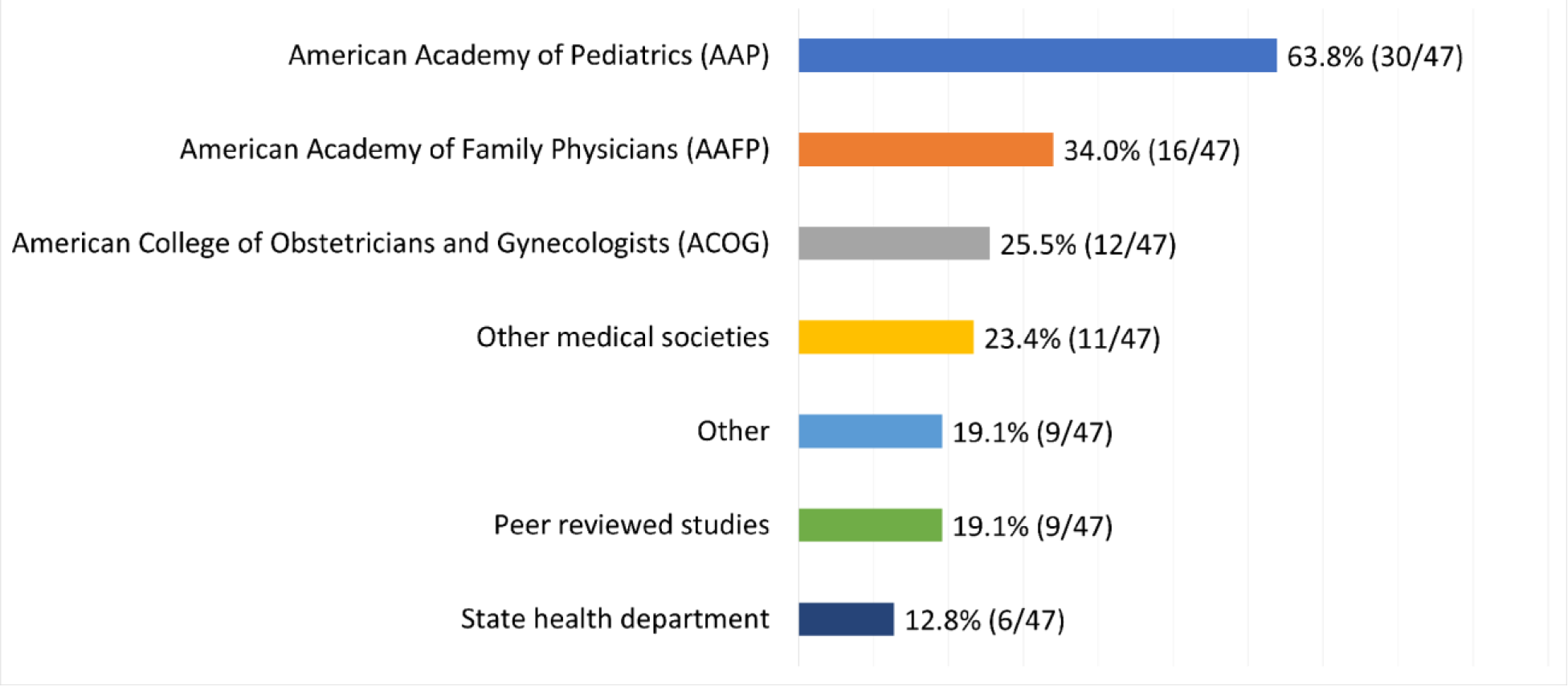
Source: Authors’ analysis. Note: Percentages sum to greater than 100 percent because a single policy may reference multiple recommending bodies.
Most policy documents that reference non-ACIP recommending bodies have done so since well before 2025. However, 10 policies were updated to point to a recommending body in addition to ACIP in June 2025 or later. Plans may have decided to add recommending bodies to their policy documents in response to changes to ACIP recommendations and state legislative changes that have incorporated non-ACIP recommending bodies into state coverage laws. Policies that reference recommending bodies in addition to ACIP do not specify which recommendation takes priority if entities have conflicting recommendations.
What Could Regulators And Insurance Plans Do To Mitigate Confusion?
Even without changes, longstanding coverage policies may still cause confusion. For example, policies that have always referenced ACIP as well as other medical societies in their coverage criteria may not have anticipated a time when those guidelines would be in conflict with one another. In addition, policies that broadly reference ACIP without specifying any details about age or risk recommendations may also be newly confusing, as consumers and providers may want and need more detail as to how the plan is defining medically necessary vaccines.
Federal Agencies And State Regulators Could Clarify That SCDM Recommendations Must Be Covered Without Cost Sharing Under The ACA
There are several steps that policy makers could consider to address the confusion wrought by ACIP changes and inconsistent coverage policies. First, federal agencies that oversee health benefits (the Departments of Health and Human Services, Labor, and Treasury, collectively the “tri-agencies”) could release official guidance clarifying that SCDM recommendations must be covered without cost sharing under the ACA’s preventive services requirements. The Centers for Medicare and Medicaid Services (CMS) has previously released similar guidance clarifying this point for Medicaid and Medicare Part D, and the tri-agencies have published reams of frequently asked questions clarifying preventive services coverage requirements over the years.
State departments of insurance could also release guidance clarifying this point. Illinois, for example, finalized a regulation clarifying that any preventive service with a SCDM recommendation must be covered by private insurers without cost sharing.
The CDC Could Better Align Its Definition Of “Routine” With The ACA’s Definition
Second, the CDC could consider updating documents describing ACIP’s evidence review and recommendation process to better align its definition of “routine” vaccines with how section 2713 of the ACA and its implementing regulations define this term in federal law and regulations governing vaccine coverage requirements.
State Coverage Laws Should Clarify Which Recommending Body Will Control.
Third, as states continue to contemplate legislation aimed at tethering state coverage requirements to a discernible evidence-based standard, they may want to be clearer on which recommending body will control if there is a conflict. Many emerging state laws updating zero-dollar coverage requirements reference a host of recommending bodies in addition to ACIP with no clear process for prioritizing one recommending body over others. Plan policies themselves often reference multiple recommending bodies as a basis for a coverage policy but are silent on how the recommending bodies should be weighed relative to one another.
Regulators Should Improve Oversight Of Compliance with Coverage Requirements
Fourth, federal and state regulators should consider ramping up oversight activities for preventive services and vaccine coverage requirements, including by reviewing plan coverage policies to ensure they don’t contain inappropriate limitations or exclusions. There have been longstanding compliance issues for preventive services requirements, particularly for services with complex or risk-based recommendations. ACIP use of SCDM is only the latest example of a confusing recommendation that may be difficult to translate into plan coverage policies.
It is clear that the vaccine landscape will be volatile for the time being, particularly as litigation plays out. However, regulators, working hand-in-hand with public health partners and insurance plans can mitigate the confusion wrought by this volatility. They can provide clear guidance and ramp up oversight activities to ensure continued access to vaccines without cost sharing.
Authors’ Note
This research was supported by a grant from the Commonwealth Fund.
Amy Killelea, Madison Harden-Stein, Abigail Knapp, and Justin Giovannelli “Will Insurance Plan Coverage Policies Help Clarify ACIP Confusion? Probably Not,” Health Affairs Forefront, September 10, 2026, https://www.healthaffairs.org/content/forefront/insurance-plan-coverage-policies-help-clarify-acip-confusion-probably-not Copyright © 2026 Health Affairs by Project HOPE – The People-to-People Health Foundation, Inc.