


The Problems

Untangling the Complex Web: Summary of a New Expert Perspective
The high cost of health care is front of mind for many American voters this election cycle, and policymakers across the political spectrum have floated reforms to bring down health care costs. However, identifying and advancing policies that truly deliver less expensive, high quality health care requires policymakers, researchers, and other stakeholder to understand how the health care system has become increasingly financially intertwined and riddled with incentives that drive costs ever higher, often at patients’ expense. In the last quarter century, the health care market has seen significant vertical and horizontal integration of health care providers and insurers, with considerable research that evidences how this consolidation leads to higher prices and lower quality of care.
While these forms of integration are vital to understand and address, we must widen this consolidation picture further. The financial interests of providers, insurers, administrative entities, and other “middleman” businesses are now strongly aligned to increase health care spending through a complex web of common ownership, contracting arrangements, and financial deals which create an array of conflicts of interests and hidden flows of money. These strongly aligned interests and relationships collectively contribute to increased health care spending through a complex web of common ownership, contracting arrangements, and financial deals which create an array of conflicts of interests and hidden flows of money (see Figure 1).
[[ACCORDION START: Read the rest of the summary here]]
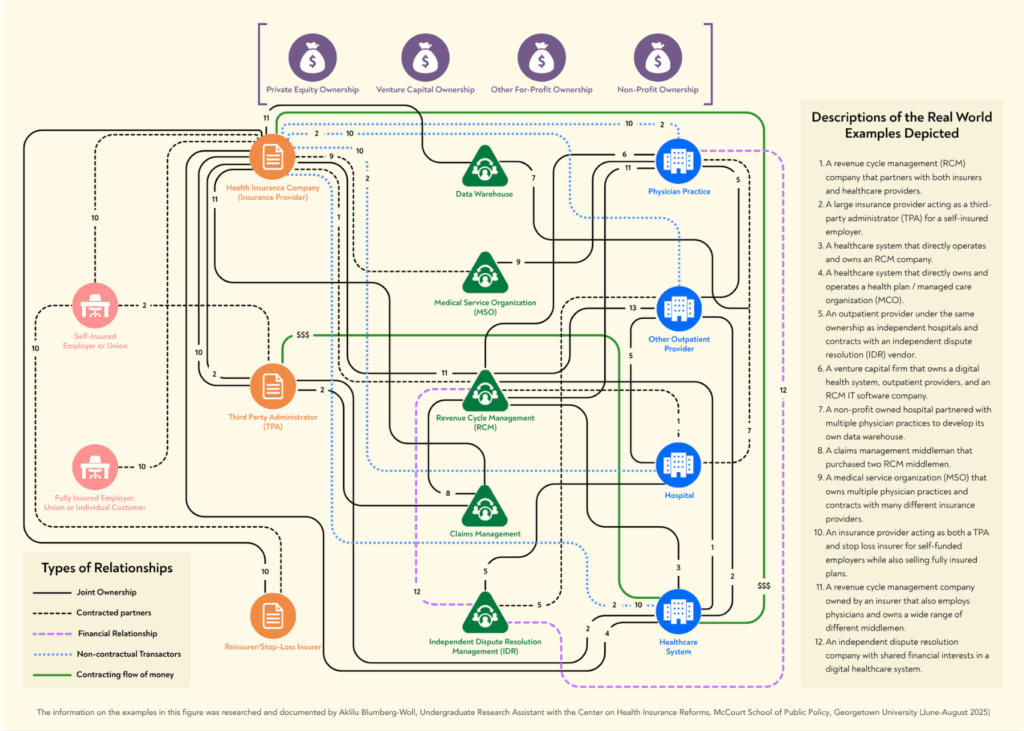
The complexity is so tremendous that it is virtually impossible to capture the entire picture of the existing financial relationships, and that is the point—through opaque relationships and hidden practices, these entities operate without sufficient oversight or limits. Despite the challenges inherent in unwinding the components of the web, it is critical that we begin to do an accounting of the current nature of our health care eco-system to understand its implications for private and government spending on health care, and, ultimately, access to and quality of care. A big-picture understanding is also critical for designing and promoting public policy approaches to rationalize health care costs and promote access to high-quality medical services.
In a recently published expert perspective, we dive into this situation and demonstrate that the proliferation of administrative and financial middlemen collaborating or entwined with insurers, TPAs, and/or providers, as well as the interrelationships between insurers, TPAs, and providers themselves, all work against an efficient market equilibrium and, instead, inflate spending on health care goods and services.
Here we present a condensed version of this expert perspective, which focuses on medical benefits and the market for commercial insurance.
Growth in Spending on Private Health Insurance is Correlated with Growth in Administrative Costs and the Middlemen Market
Spending on private health insurance has grown considerably in the last decade. As total expenditures on private health insurance more than tripled from 2020 to 2023, so too did the net cost of health insurance, also known as administrative costs ($150.78 billion in 2023). This administrative spending outpaced the growth in private health insurance spending on physician and clinic services, retail drugs, and all other expenses collectively, except for hospitals. Although some of these administrative costs are necessary to run a health system, experts posit that at least half of health care administrative costs in the U.S. are wasteful.
This wasteful spending appears closely correlated to the size and scale of health care administrative and financial middlemen, an industry that has skyrocketed in size in recent years. In 2024, the market for only one type of middleman – revenue cycle management (RCMs) companies – was estimated at a value of $172.24 billion, and it is expected to grow by another 10 percent by 2030. The broader middleman industry includes, but is not limited to, RCMs, re-pricers, claims denial management firms, independent dispute resolution management companies, data warehouses, and point solution vendors. Each of these middlemen profit by increasing revenue for insurers, providers, and sometimes both, and the fees paid to them add to provider prices and/or the administrative costs baked into private health insurance premiums.
Multifaceted Market Failures Underscore Why and How this Complex Web has Arisen and Increased Costs
Several reasons explain how and why this web has grown so entangled: providers dominate many markets, insurers and third-party administrators (TPAs) have financial interests to keep spending high, and middlemen profit from repeated adjudication of claims and other fees associated with an ever more complex system. We explore each of these reasons briefly below, and additional explanation and examples can be found in the full expert perspective.
Many Providers Face No Constraints on Pricing in Private Markets and Use Various Tools to Maximize Revenue and Hold Down Input Costs
The research evidence is clear that as health care providers consolidate ownership with other providers—for example, multiple hospitals merging to form a chain or hospitals integrating with physician practices—the prices paid for their care increase and insurance premiums rise, with no commensurate increase in the quality of care or improved clinical outcomes. Health care providers can extract higher revenue through unfair billing practices like facility fees, and through various types of anti-competitive behavior that increase the average cost of medical claims, thereby increasing patient out-of-pocket costs as well as insurance premiums paid by consumers and employers. Anecdotal evidence indicates that, in order to secure their place in plans’ networks, consolidated providers have required insurance companies to guarantee the providers a minimum level of revenue across some or all of an insurers’ lines of business, and this may result in extra payments above the negotiated rate for a subset of services determined by the insurer.
In a competitive market, health care providers’ profit motive would not necessarily be problematic, as health care purchasers vying for market share could exert downward pressure on prices until an efficient equilibrium was reached. Purchasers are most often not in a competitive market, however, and this is not only because of horizontal and vertical integration among health care providers. Provider consolidation has been coupled with more varied types of consolidation of ownership and financial interests across health industry stakeholders. For example, insurers and TPAs have incentives to drive spending on claims upward, contrary to what some of their clients may expect. Because their incentives are significantly aligned with those of providers, many providers and insurers see the profit potential from integrating with each other as well.
Insurers Have Financial Interests in Keeping Health Care Spending High
While providers often have the market power to demand and extract high prices, insurers also have incentives to keep spending high. First, federal medical loss ratio (MLR) limits — intended to prevent insurers from selling low-value plans — have unintentionally contributed to higher prices: insurers make greater profits when provider prices are higher under their fully insured plans. Second, in some cases, the insurer and health care providers are owned by the same entity, creating financial incentives for the insurer to increase spending on those providers in particular. And third, major insurers have contracts with and sometimes share ownership or other business relationships with middlemen companies that increase the insurers’ own revenue and profits as claims increase.
Many TPAs Have Financial Interests That Tend to Increase Health Spending, and Employers Have Limited Choice in TPAs
Importantly, because employers are not purchasing health insurance in a competitive market, employers cannot “solve” these problems or disincentivize high spending from insurers or providers. The TPA market administers health plans for self-funding employers, and it is dominated by the BUCAs (Blue Cross affiliates, United, Cigna, and Atena), entities which have their own interests to increase financial relationships and claims costs. Lawsuits brought by employers and investigative journalism suggest that some TPAs then employ strategies hidden from employers – such as “skip” lists, cost-plan offsetting, shared savings, and more – to accrue billions of dollars in revenue at the expense of the employer, their workers, and a competitive market. These opaque agreements between TPAs, providers, and middlemen are often unknown or misunderstood by employers, the dominance of the BUCAs give even the largest employers few feasible alternatives, and the TPAs provide little information to employers about how their money is actually being spent.
Middlemen Make Money by Repeated Adjudication of Claims and Higher Costs
Amidst these provider, insurer, and TPA markets, middlemen entities have entered to further maximize profit for the other stakeholders and themselves. While middlemen entities promise greater efficiency and billing accuracy for their clients, the fees of this large and fast-growing industry are subsumed in insurance premiums and patient out-of-pocket payments, and there is growing concern of financial conflicts of interest and insufficient government oversight of their operations.
Middlemen are sometimes independent with financial interests tied to increasing revenue for providers or insurers through a system of fees; sometimes middlemen are subsidiaries of one of the stakeholders; and sometimes middlemen are owned by private equity firms that also own one or more other health care stakeholders. Some of the middlemen companies contract with both insurers and providers, promising increased revenue to both, and creating a system of repeated adjudication between the different arms of the same company, profiting themselves regardless of the outcome, with the incentive being for higher billing and greater numbers of disputes challenging the bills.
While some of the middlemen entities are long-standing members of the market, such as RCMs, new types of middlemen emerge wherever market advantages can be found. Take for example, HaloMD. This independent dispute resolution (IDR) management company arose only after the passage of the No Surprises Act and the creation of the federal IDR process. By handling the IDR process primarily for providers — through dispute submission, negotiation, offer analysis, and more — these entities profit from high-volumes of high payment determination awards. And so far, HaloMD has been quite successful: across all disputes, HaloMD has secured a median award of 934 percent of the qualifying payment amount (a proxy for in-network rates). These IDR management companies, like so many other middlemen, have a clear motivation to maximize reimbursement for providers, which will ultimately increase health care costs and overall spending.
Action is Needed: Left Untouched, The Complex Web Will Continue to Grow and Harm Patients
An intricately complex health care financial web is undoubtedly driving health care prices and aggregate spending upward. Left alone to market forces, spending will continue to climb, likely at accelerating rates. The heightened focus of health care entities on ownership and contracting relationships that increase revenue and profitability are likely to take an increasingly negative toll on quality and access to necessary care as well. Developing effective policy solutions requires an understanding of the existing financial incentives and how they are intertwined across stakeholders of various types. Because the profit motive is so strong and currently unrestrained in commercial markets, and because the financial standing of the broad array of health care entities have become so interdependent, no single incremental policy strategy will suffice to address the consequences of the status quo. However, a set of policy strategies at the federal and state level have the potential to constrain the current cost growth trajectory by eliminating perverse financial incentives and disentangling the profit-driven relationships that have put insurers, providers, and their middlemen currently at cross purposes to consumers, employers, and governments.
[[ACCORDION END]]
| Title | URL as plaintext | Image as a URL | Publication Date | Author | Summary |
|---|---|---|---|---|---|
| Third-Party Administrators – The Middlemen of Self-Funded Health Insurance | https://chir.georgetown.edu/third-party-administrators-the-middlemen-of-self-funded-health-insurance/ | https://chir.georgetown.edu/wp-content/uploads/fa-calc2.jpg | May 28, 2025 | Karen Handorf, Christine H. Monahan, and Kennah Watts | While TPAs claim to lower medical costs––similar to PBMs’ assertions that they reduce drug costs––allegations made in litigation suggest this is not often the case. Other lawsuits and investigations raise concerns that TPAs are imposing hidden fees, benefiting from their own form of spread pricing, and otherwise prioritizing their own financial interests over their health plan clients when negotiating contracts and administering claims. Despite provisions in the Consolidated Appropriations Act of 2021 intending to allow employer plans to “look under the hood” at their health care claims data and compensation TPAs and other service providers receive, TPAs continue to obstruct employer efforts to monitor health plan spending and quality of care. |
| Title | URL as plaintext | Image as a URL | Publication Date | Author | Summary |
|---|---|---|---|---|---|
| Spending on IDR Process Pushes No Surprises Act Costs to More than $22.4 Billion Over Just Four Years | https://chir.georgetown.edu/spending-on-idr-process-pushes-no-surprises-act-costs-to-more-than-22-4-billion-over-just-four-years/ | https://chir.georgetown.edu/wp-content/uploads/reform-objects-GettyImages-510968592.avif | August 2026 | Jack Hoadley and Kennah Watts | The trends in IDR dispute volume, the magnitude of IDR awards, and the resulting IDR costs far exceed anyone’s expectations from when the NSA became law. All stakeholders—providers, plans, and the IDR entities—have complex incentives with regard to how they use the system. |
| The No Surprises Act IDR Process: An Early Look at 2025 Data | https://chir.georgetown.edu/the-no-surprises-act-idr-process-an-early-look-at-2025-data/ | https://chir.georgetown.edu/wp-content/uploads/HCRledgerGettyImages-882383862.avif | March 30, 2026 | Jack Hoadley, Kennah Watts, Katie Keith, and Ellie DeGarmo | The most recent IDR data from 2025 underscore continued concerns about rising volume and costs associated with the federal IDR system. The volume of disputes for the first half of 2025 was nearly double the number of disputes from the first half of 2024—with administrative costs that, in only six months, were nearly as high as the total administrative costs from 2022 to 2024. There is no reason to think these trends will not continue. In addition,litigation over the No Surprises Act will undoubtedly continue. Courts will continue to grapple with the question of whether providers (or plans) have a private right of action under the No Surprises Act. Even as plans newly take to the courts, any judicial relief will be delayed. |
| The Healthcare Policy Podcast: Georgetown Professor Linda Blumberg Discusses Commercial Health Insurance “Middlemen” | https://www.thehealthcarepolicypodcast.com/p/georgetown-professor-linda-blumberg | https://chir.georgetown.edu/wp-content/uploads/home-audio-GettyImages-2204556711.jpg | November 18, 2025 | Linda J. Blumberg | Insurer and provider relationships with middlemen have resulted in a complex web of cost increasing incentives, money flows, and conflicts of interest. The complexity is so tremendous that it is virtually impossible to capture the entire picture of the existing financial relationships |
| The Substantial Costs of the No Surprises Act Arbitration Process | https://chir.georgetown.edu/the-substantial-costs-of-the-no-surprises-act-arbitration-process/ | https://chir.georgetown.edu/wp-content/uploads/paper-work-GettyImages-2166302030.jpg | September 24, 2025 | Jack Hoadley and Kennah Watts | The high volume of IDR disputes is generating significant spending from administrative costs and higher payments for services. This higher spending will likely be reflected in higher overall health costs and consumer premiums in the future. By estimating administrative and payment costs, and we find the IDR process has generated at least $5 billion in total costs through the end of 2024. In the nine months after the system opened in 2022, about 190,000 disputes were filed—more than ten times the number expected for the first full year alone. In 2024, providers won 85 percent of the line-item claims decided that year, up from 81 percent in 2023. |
| No Surprises Act Arbitrators Vary Significantly in their Decision-Making Patterns | https://chir.georgetown.edu/no-surprises-act-arbitrators-vary-significantly-in-their-decision-making-patterns/ | https://chir.georgetown.edu/wp-content/uploads/our-work_health-insurance-coverage_behavioral-health-coverage__-what-we-do.png | July 10, 2025 | Kennah Watts and Jack Hoadley | Our analysis indicates that IDR entities vary significantly in their decision-making practices despite expectations that decisions would be consistent across entities. Our stakeholder discussions suggest that parties may strategically veto particular IDR entities. Our analysis sheds some light on variations already known to provider and payer stakeholders engaging in IDR. More transparency in the PUFs would improve our understanding of the IDR process. In addition, the rationale behind payment determinations remains unclear due to limited transparency into how IDR entities evaluate submissions. Plus, given that IDR entities determine case eligibility and are only paid for eligible cases, some stakeholders suggest that IDR entities are incentivized to determine ineligible cases as eligible. |
| The Incursion of Profit-Enhancing Middlemen in US Health Care | https://chir.georgetown.edu/the-incursion-of-profit-enhancing-middlemen-in-us-health-care/ | https://chir.georgetown.edu/wp-content/uploads/blurry-cityscape-background-GettyImages-2163444910.jpg | November 4, 2024 | Linda J. Blumberg and Kennah Watts | The U.S. health care system, by and large, does not regulate the prices providers charge in the commercial market, nor oversee private insurer claims decisions, particularly denials. Combined with the accelerating corporatization of health care delivery, this regulatory vacuum has fostered an ever-growing market for intermediary businesses to help clinicians navigate the processes of filing claims and maximizing reimbursements. At the same time, insurers increasingly contract with intermediary businesses in an effort to manage utilization and up their own margins. These competing “profit-enhancing middlemen” are likely increasing costs for consumers and spending in the private sector health system as a whole. |
| Title | URL as plaintext | Image as a URL | Publication Date | Author | 1-sentence Summary |
|---|---|---|---|---|---|
Hollowed Out: How Private Equity Destabilized Safety-Net Hospitals in Pennsylvania, Connecticut, and Rhode Island | https://georgetown.app.box.com/s/k1po5obmxf5o6jgv5uyb45kup33luc38 | https://chir.georgetown.edu/wp-content/uploads/hollowed-out-cover-complex-web.png | July 2026 | Karen Davenport and Kennah Watts | The extremes of the private equity playbook of asset extraction and profit maximization are on full view in Prospect’s recent bankruptcy. Prospect, as controlled by the private equity firm Leonard Green & Partners (LGP), used various asset-stripping and profit-maximization strategies across their multi-state hospital system with disastrous results. |
| The Outpatient Pivot: How Prospect Exploited Facility Fees While Inpatient Care Crumbled | https://chir.georgetown.edu/the-outpatient-pivot-how-prospect-exploited-facility-fees-while-inpatient-care-crumbled/ | https://chir.georgetown.edu/wp-content/uploads/chalkboard-health-policy-GettyImages-477134468.jpg | July 2026 | Karen Davenport and Kennah Watts | Given the potential for significant revenue from outpatient facility fees, private equity investors have a strong incentive to maximize HOPD services. So, while Prospect focused on extracting hospital assets through debt loading, sale-leasebacks, and other extractive strategies, it also advanced revenue-rich business lines related to outpatient care. |
| Evidence on Private Equity Suggests that Containing Costs and Improving Outcomes May Go Hand-in-Hand | https://chir.georgetown.edu/evidence-on-private-equity-suggests-that-containing-costs-and-improving-outcomes-may-go-hand-in-hand/ | https://chir.georgetown.edu/wp-content/uploads/cost-quality-slider-GettyImages-2182421326.jpg | April 29, 2024 | Linda J. Blumberg and Kennah Watts | There is ample evidence that PE acquisition of nursing homes has led to reduced quality of care and growing evidence of lower quality and higher costs for PE-acquired hospitals. Evidence on physician practices is more mixed, with limited data and research. These findings underscore the importance of greater transparency on PE ownership and greater ability to track costs and outcomes differentials by ownership type. Contrary to popular misconception, it is clear that higher prices of PE-acquired providers are not associated with higher quality of care––in fact, the opposite may be true in substantial numbers of situations. |
| Title | URL as plaintext | Image as a URL | Publication Date | Author | 1-sentence Summary |
|---|---|---|---|---|---|
| Implications of Vertical Integration for Patients, Providers, and Employers: Themes from a CHIR Briefing | https://chir.georgetown.edu/implications-of-vertical-integration-for-patients-providers-and-employers-themes-from-a-chir-briefing/ | https://chir.georgetown.edu/wp-content/uploads/chalkboard-health-policy-GettyImages-477134468.jpg | June 18, 2026 | Julia Burleson and Lachlan Vaughn | Themes from the discussion included that consolidation can increases costs without improving quality, and that growing vertical integration challenges traditional antitrust analysis. Panelists also noted that opaque corporate structures can obscure oversight, and financial interests can drive health care consolidation. As health care organizations become larger and more interconnected, policymakers face growing challenges in understanding how consolidation affects competition, costs, and patient care. The panelists at the CHIR briefing suggested that effective oversight will require updated enforcement frameworks, greater transparency into ownership and financial relationships, and policy tools that curb consolidation as well as financialization. |
| Vertical Integration in Health Care: Implications for Consumers, Employers, and Clinicians | https://chir.georgetown.edu/vertical-integration-in-health-care-implications-for-consumers-employers-and-clinicians/ | https://chir.georgetown.edu/wp-content/uploads/care-dice-GettyImages-1249188236.jpg | May 12, 2026 | Julia Burleson | Over the past decade, evidence of higher prices and constrained competition suggest that many of the expected efficiency gains from vertical integration have been more theoretical than real. Instead, the dominant effects have been rising costs for consumers and employers and reduced competitive pressure among providers. Evidence has shown that integration has been used to enhance revenue rather than improve efficiency or lower costs to consumers. Momentum is building toward more intensive scrutiny of vertically integrated entities and the financial relationships that link insurers, providers, and health care intermediaries. |
| From Check-Ups to Cha-Ching: Consumers’ Exposure to Facility Fees | https://chir.georgetown.edu/from-check-ups-to-cha-ching-consumers-exposure-to-facility-fees/ | https://chir.georgetown.edu/wp-content/uploads/hcr-flag.avif | December 15, 2025 | Karen Davenport and Kennah Watts | With the increasing rise of vertical integration and the growth in consumers’ out-of-pocket responsibilities, patients are more exposed to facility fees than ever. In response, some states have enacted targeted facility fee prohibitions and out-of-pocket protections that shield consumers from at least some of these fees, while a larger number of states have created consumer notification requirements that at least ensure that patients know when to expect facility fee bills. As they seek to improve health care affordability and access for their consumers, state policymakers may consider these reforms, or investigate site-neutral payment—another approach that also targets the site-dependent differences in payment rates that drive vertical integration and the proliferation of facility fee charges. |